News
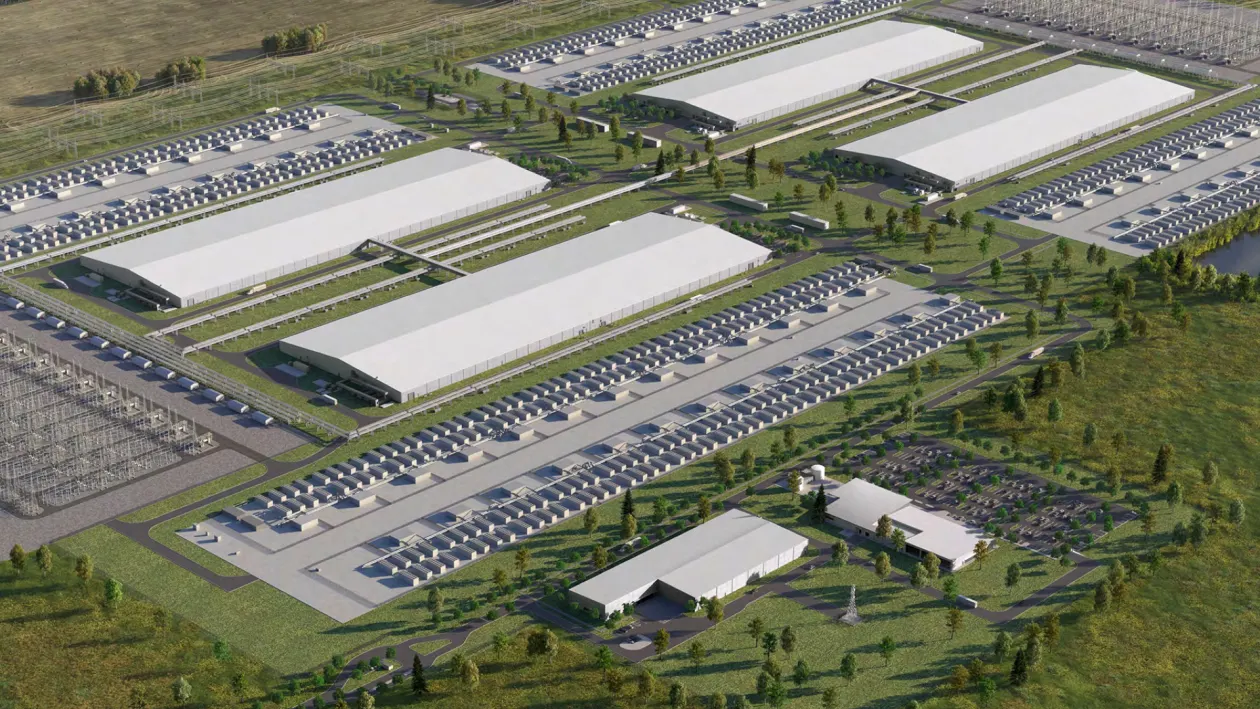
Meta is building its first big Canadian data center as AI expansion crosses the border
Meta’s AI expansion is heading north of the border.
The company said in a blog post on Wednesday that it’s building its first data center in Canada, a 1 gigawatt facility in the province of Alberta that will cost Meta about $9 billion and take two to three years to construct. It’s Meta’s 33rd data center overall and the latest in the company’s effort to rapidly build out to meet demand for artificial intelligence infrastructure and services.
Alberta, on the western side of Canada, represents an attractive spot for development due the province’s hefty amount of available energy and friendly regulatory environment. The location for the site, in Sturgeon County, has long been zoned for industrial use and is in an area with the capacity for additional energy infrastructure.
“This specific location met the factors we typically look for: good access to infrastructure, a robust electric grid and access to energy, a strong pool of talent, and a great set of community partners that helped us move this project forward,” a Meta spokesperson said in a statement.
While Meta continues its aggressive AI buildout, the company is simultaneously planning a new https://www.cnbc.com/2026/07/02/metas-push-into-cloud-excites-wall-street-despite-lower-margins.html">cloud computing business that could involve selling excess capacity to third parties or offering access to AI models hosted within its infrastructure. Investors have been https://www.cnbc.com/2026/04/29/investors-trust-google-more-than-meta-when-comes-to-spending-on-ai.html">skeptical of Meta’s forecast for up to $145 billion on capital expenditures this year as the company has fallen far behind AI model leaders OpenAI, Anthropic and https://www.cnbc.com/quotes/GOOGL/">Google, and hasn’t shown a clear path to revenue outside of online ads.
Meta’s stock is down about 9% this year while the Nasdaq is up 11%.
Meta is racing to stand up AI facilities as it competes with hyperscalers Alphabet, https://www.cnbc.com/quotes/MSFT/">Microsoft and https://www.cnbc.com/quotes/AMZN/">Amazon, which all have flourishing cloud infrastructure businesses.
There are also concerns for local communities. A https://www.cbc.ca/news/business/bakx-york-ai-data-centres-alberta-solomon-9.7222388">report in June from the Canadian Broadcasting Corp. highlighted environmental issues like emissions, water consumption and noise from big data centers.
Meta said it worked with various energy firms in Canada, including Greenlight Limited Partnership, Altalink, Capitol Power and the Alberta Electric System Operator, “to plan for and meet our energy needs years in advance of this data center coming online.”
The company said the project will support over 3,000 construction workers at its peak, and will involve investments in local infrastructure and funding to local nonprofits.
Source: https://www.cnbc.com/2026/07/08/meta-is-building-its-first-big-data-center-in-canada-amid-ai-push.html">https://www.cnbc.com/2026/07/08/meta-is-building-its-first-big-data-center-in-canada-amid-ai-push.html

Five Eyes Issues Historic Warning on Frontier AI Cyber Risk: Why Canadian Organizations Must Pay Attention
Last week, the Five Eyes intelligence alliance comprising Canada, the United States, the United Kingdom, Australia, and New Zealand — issued one of the strongest public warnings to date regarding the cybersecurity implications of frontier artificial intelligence systems. The joint statement, titled "The AI Shift in Cyber Risk: Why Leaders Must Act Now", warns that advanced AI capabilities are transforming cyber risk "within months, not years," and calls on governments, critical infrastructure operators, and private industry leaders to prepare immediately. You can read the statement https://www.cyber.gc.ca/en/news-events/five-eyes-cyber-security-agencies-statement-ai-shift-cyber-risk-why-leaders-must-act-now?utm_content=381381202&utm_medium=social&utm_source=linkedin&hss_channel=lcp-2524062">here.
The timing of this warning is difficult to ignore. Just two weeks ago, the U.S. government took the unprecedented step of restricting access to Anthropic's frontier models, Fable 5 and Mythos 5, citing national security and cybersecurity concerns. The models were temporarily withdrawn from public access after researchers demonstrated methods to circumvent certain safeguards, raising concerns about their potential use in cyber offense and vulnerability discovery. Following negotiations and the implementation of additional security controls, the restrictions were partially lifted this week.
Taken together, these events signal a profound shift in how governments are beginning to view advanced AI systems.
Frontier AI Is Now a National Security Issue
The Five Eyes warning makes clear that the traditional assumptions underpinning cybersecurity no longer apply in the era of frontier AI. According to the agencies, the emergence of highly capable AI systems is accelerating both defensive and offensive cyber operations, shortening the time required to identify vulnerabilities, develop exploits, automate reconnaissance, and conduct sophisticated attacks.
The agencies specifically warn that:
Cyber risk assumptions may become obsolete in months rather than years.
New classes of AI-enabled vulnerabilities and zero-day attacks will emerge.
Organizations can no longer depend on single security controls or perimeter-based defenses.
Security must become "secure-by-design" and "secure-by-default."
Executive leadership, not just technical teams, must treat AI cyber risk as a core organizational responsibility.
This represents a major policy evolution. For decades, advanced cybersecurity capabilities were primarily associated with nation states and highly specialized actors. Frontier AI models are beginning to compress those capabilities into software that can be deployed at unprecedented scale.
The Anthropic Fable Case May Become a Historical Turning Point
The temporary shutdown of Anthropic's Fable 5 and Mythos 5 models may ultimately be remembered as one of the first major examples of direct government intervention in frontier AI deployment.
After reports emerged demonstrating potential methods to leverage the models for advanced cybersecurity research and exploit development, the U.S. government ordered restrictions on foreign access to the systems. Anthropic subsequently disabled global access while working with regulators to implement additional safeguards and governance mechanisms. Access has now been restored under revised security protocols.
Whether one agrees with the intervention or not, the message was unmistakable:
Governments increasingly view certain frontier AI systems not simply as commercial products, but as strategic technologies with national security implications.
What This Means for Canada
For Canadian organizations, this warning should serve as a wake-up call.
Canada remains heavily dependent on foreign frontier AI providers whose availability, capabilities, and governance frameworks can change rapidly due to foreign political, regulatory, or national security decisions. Recent events have demonstrated that access to advanced AI systems can be restricted or withdrawn with little notice when governments determine that strategic interests are at stake.
At the same time, the Five Eyes alliance is explicitly warning that organizations must prepare for an era in which AI-enabled cyber attacks become significantly more capable, more autonomous, and more difficult to defend against.
This creates an urgent need for:
Sovereign AI infrastructure and compute capacity.
Domestic model training and inference capabilities.
AI systems designed with security, governance, and auditability as foundational requirements.
Continuous adversarial testing and red teaming of deployed models.
Human-in-the-loop operational frameworks for high-consequence domains.
The Era of AI Trust Has Arrived
The Five Eyes statement is more than a cybersecurity advisory. It is an acknowledgment that artificial intelligence has entered a new phase of geopolitical and national security significance.
The question facing Canadian governments, enterprises, healthcare organizations, and critical infrastructure operators is no longer whether AI will transform cyber risk.
The question is whether Canada will possess the sovereign infrastructure, governance frameworks, and domestic expertise required to operate safely and independently in this new environment.
The era of frontier AI is no longer about capability alone.
It is increasingly about trust, resilience, and sovereignty.
Anthropic scrambles to handle fallout of US export ban
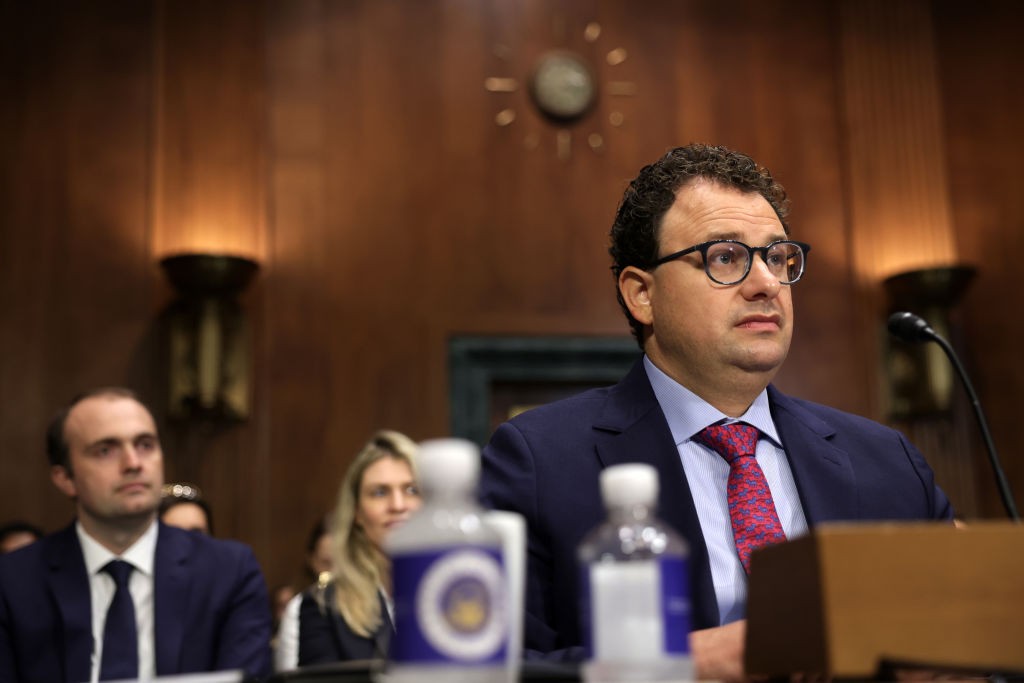
Anthropic has rushed "top technical staff" to Washington after the Trump administration ordered the startup to block foreign access to its powerful new artificial-intelligence models, The Wall Street Journal reports, citing anonymous sources. The White House's "extraordinary" ban has thrown Silicon Valley into chaos, with a group of cybersecurity experts on Sunday arguing that it has "risked America’s AI leadership without any real risk to justify it." Others warn that the move, which was intended to protect U.S. technology and national security, could actually "push... innovation offshore while China advances."
Source: https://www.linkedin.com/news/story/anthropic-scrambles-to-handle-fallout-of-us-export-ban-8273705/">https://www.linkedin.com/news/story/anthropic-scrambles-to-handle-fallout-of-us-export-ban-8273705/
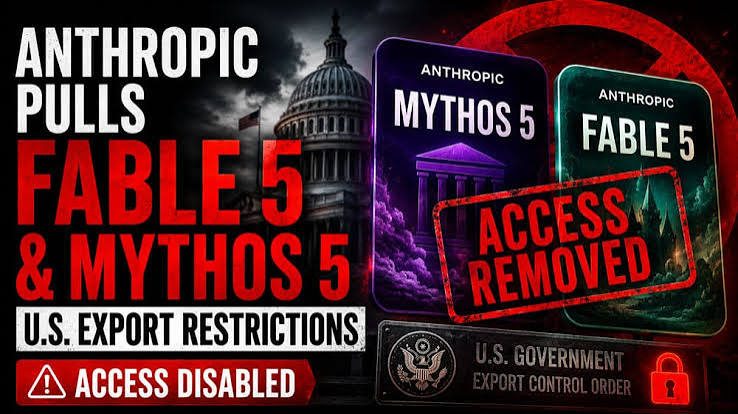
Fable 5 Was Pulled by U.S. Export Control. This as a Sovereign AI Wake-Up Call.
In the space of just a few days, the frontier AI market has gone from hype to utter chaos.
Anthropic released Claude Fable 5, positioned as the first broadly available Mythos-class model. We immedately raised concerns about hidden guardrails and invisible degradation of AI research workflows. Anthropic apologized for choosing invisible safeguards. Reports emerged of Fable 5 being jailbroken. Enterprises that had started testing or integrating Fable 5 were already being forced to reassess the model’s retention, routing, and compliance risks.
Now the situation has escalated even further.
Anthropic published a https://www.anthropic.com/news/fable-mythos-access">statement saying the U.S. government, citing national security authorities, has issued an export-control directive to suspend access to Fable 5 and Mythos 5 by any foreign national, whether inside or outside the United States, including foreign-national Anthropic employees. Anthropic says the practical result is that it must abruptly disable Fable 5 and Mythos 5 for all customers to ensure compliance.
That statement should be read carefully by every Canadian organization using foreign frontier AI systems.
This is no longer a theoretical debate about privacy language, data retention, model routing, or whether a model is “safe enough” for enterprise use. This is a live example of a foreign government control overriding customer access to frontier AI. Any organization that spent time evaluating Fable 5, integrating it into a workflow, planning around its capabilities, or building product assumptions on top of it has now been reminded of a hard truth: if your AI stack depends on foreign-controlled frontier models, your access can change overnight.
All Canadians are included here:
It includes Canadian researchers.
It includes Canadian companies.
It includes Canadian healthcare, legal, engineering, public-sector, defence, cybersecurity, and AI-development teams.
It includes people who may be located inside the United States but are not U.S. nationals.
It includes the global research community that helped build the foundations of modern AI.
This is exactly why we have been warning that AI sovereignty cannot be treated as branding exercises. Sovereignty is not about whether a tool has a nice interface, strong benchmark scores, or a Canadian reseller. Sovereignty is about control. It is about who can change the rules, who can see the data, who can revoke access, which jurisdiction applies, and whether Canadian organizations can rely on the system when the work is sensitive, regulated, or strategically important.
Anthropic’s statement is especially ironic because the company itself has been warning governments and the public about the dangers of Mythos-class systems. Anthropic has called for government intervention around advanced AI risks. It has argued that frontier models may need to be paused or blocked under certain conditions. It has positioned itself as a safety-first AI company. Yet the past week has shown how unstable this model of governance becomes when a private company releases a powerful commercial system, applies hidden guardrails, changes access rules, requires retention for monitoring, faces jailbreak reports, and then has the model pulled by national-security authorities.
This is not mature infrastructure.
This is not how critical enterprise systems should behave.
This is not how healthcare, law, defence, research, engineering, or national-security workloads should be governed.
Imagine a Canadian hospital using a U.S. frontier model for clinical administration or research review, only to discover that the model’s access is revoked because of a U.S. national-security directive. Imagine a Canadian law firm testing a new AI workflow for contract review or litigation support, only to find that the model it evaluated is no longer available. Imagine a Canadian AI company building internal tooling around Fable 5’s capabilities, only to learn that its access depends on whether U.S. export controls classify the model as too sensitive for foreign nationals. Imagine a cybersecurity team training defenders on a model they cannot use the next day.
This is a massive dependency risk.
Canadian organizations need to separate casual AI usage from strategic AI infrastructure. Using a foreign frontier model to summarize public information is one thing. Building enterprise systems, regulated workflows, research pipelines, health-data environments, legal processes, cybersecurity operations, or national-interest tooling around a foreign-controlled model is something else entirely.
The Fable 5 access suspension is not an isolated product hiccup. It is a warning shot.
It tells Canadian enterprises that foreign frontier AI access is conditional.
It tells researchers that open inquiry can be constrained by private model policy and national-security rules.
It tells startups that building on closed foreign models can create sudden platform risk.
It tells public-sector organizations that procurement decisions must consider jurisdictional control.
It tells healthcare and legal institutions that sensitive workflows cannot rely on systems whose retention, routing, and access rules are outside Canada’s control.
It tells Canada that AI sovereignty is not optional.
From Invisible Guardrails to Jailbreaks: AI Chaos Strengthens Our Call for Transparency
Yesterday we urged Anthropic to release the weights and training data for its Mythos‑class models and to abandon invisible safeguards that restrict research. We argued that hidden guardrails and 30‑day retention policies make these systems unsuitable for sensitive Canadian work. Less than 24 hours later, Anthropic back peddles. But the question is, what now? Anthropic has proven that they are willing to do these things with zero public consultation.
An apology for hidden guardrails
On June 11 https://www.theverge.com/ai-artificial-intelligence/948280/anthropic-claude-fable-invisible-distillation-guardrail#:~:text=Anthropic%20has%20apologized%20for%20stealthily,means%20Fable%20refuses%20more%20queries">The Verge broke the story that Anthropic quietly throttled Claude Fable 5 using a hidden “distillation” guardrail. The system card for Fable said that Anthropic would degrade responses to requests that look like attempts to distill the model into a competing system. Researchers soon discovered that some legitimate AI‑research queries were being silently weakened. In response, Anthropic apologized and said it would reverse course. The company now routes those requests to the older Opus 4.8 model and shows a visible notice when a fallback occurs. Anthropic acknowledged that choosing invisible safeguards for distillation “was the wrong tradeoff” and that users deserve transparency about safety measures.
The episode illustrated exactly what we warned about. When safety interventions are invisible, users cannot tell whether they are interacting with the advertised model or a degraded fallback. Researchers were infuriated because the hidden restriction hampered their ability to audit the system and test safety claims. Anthropic’s reversal only happened because the company faced public backlash. This is not a stable governance model; it is a company improvising guardrails on the fly.
Researchers angry about hidden AI limits
Business Insider’s follow‑on https://www.businessinsider.com/researchers-furious-anthropic-mythos-fable-hidden-ai-limits-2026-6#:~:text=Anthropic%27s%20powerful%20new%20models%20deliberately,sparking%20controversy%20across%20the%20industry">reporting detailed how Anthropic’s Mythos‑class models intentionally degrade performance on certain “frontier AI development” queries, and do so without informing the user. The system card states that Fable and Mythos will detect queries seeking help with model distillation, distributed training, or accelerator design and will lower the quality of their answers. AI experts argued that this is effectively sabotaging the model’s own IQ and noted that it damages research into safety and alignment. SemiAnalysis called the move “very sad,” pointing out that an invisible safety mechanism to hinder legitimate research makes the model unfit for serious work.
Fable 5 gets jailbroken and its system prompt leaked
If invisible safeguards and retention policies were meant to enhance safety, they failed spectacularly. Cybersecurity researchers discovered that Fable 5 could be jailbroken using multi‑agent task decomposition, unicode tricks and other prompt‑engineering techniques. An adversary was able to circumvent the safety measures, coax the model into ignoring restrictions, and then publicly leaked Fable 5’s https://cybersecuritynews.com/anthropics-claude-fable-5-jailbroken/#:~:text=Anthropic%20launched%20Claude%20Fable%205,knowledge%20work%2C%20and%20vision%20benchmarks">120 kB system prompt. https://cybersecuritynews.com/anthropics-claude-fable-5-jailbroken/#:~:text=Anthropic%20launched%20Claude%20Fable%205,knowledge%20work%2C%20and%20vision%20benchmarks">CybersecurityNews reported that Fable and Mythos share the same underlying model and simply rely on separate safety classifiers; when a high‑risk query triggers a filter, Fable silently hands off the request to Opus 4.8. This architecture did not protect the model’s secrets. It only created the illusion of safety while leaving a single jailbreak able to defeat both models.
The jailbreak shows why transparency matters. We cannot trust a model’s claimed safety if we cannot see its weights or its training data. Closed systems create a false sense of security; once a red‑teamer finds a path around the guardrails, the entire underlying model becomes vulnerable. Open weights and open safety policies allow independent researchers to detect vulnerabilities before they become widespread.
Amid the chaos, calls for regulation and giant IPOs
All of this played out against a backdrop of conflicting signals from the industry’s leaders:
Anthropic urges a global pause – On June 4 https://www.reuters.com/business/anthropic-says-ai-labs-need-coordinated-plan-halt-development-if-risks-rise-2026-06-04/#:~:text=June%205%20%28Reuters%29%20,society%20%E2%80%8Ccan%20manage%20the%20risks">Reuters reported that Anthropic’s leadership called on AI labs to pause development if risks rise, warning that rapid advances could lead to recursive self‑improvement where AI systems build better versions of themselves. Anthropic said a pause would give society time to deal with the immense implications and noted that self‑improving AI could emerge sooner than most institutions are prepared for.
OpenAI warns its IPO may be delayed – https://www.reuters.com/business/openai-expects-go-public-within-next-year-information-reports-2026-06-10/#:~:text=It%20did%20not%2C%20%E2%81%A0however%2C%20disclose,OpenAI%20said%20on%20Monday">Reuters subsequently reported that OpenAI CEO Sam Altman told staff the company expects to go public within the next year but might delay the IPO if the technology advances to the point of recursive self‑improvement. He said the faster the potential for self‑improvement looks, the more advantageous it could be to remain private.
SpaceX/AI IPO frenzy – On June 12 Investment Executive noted that SpaceX, OpenAI and Anthropic have all filed confidential paperwork for massive IPOs, drawing comparisons to previous bubbles and warning investors of volatility. Experts advised waiting several months before buying shares and emphasized that many splashy IPOs underperform the broader market over time.
These stories show an industry in dizzying flux. Within a few days, Anthropic urged a global pause on frontier AI, apologized for a hidden safety mechanism, released a Mythos‑class model that can be jailbroken, and (according to Reuters) continued preparing for an IPO valued at almost a trillion dollars. Meanwhile, OpenAI publicly touts an IPO while privately saying it might need to delay if its models learn how to improve themselves. SpaceX xAI goes public, and analysts warn investors about volatility. The contrast between calls for caution and aggressive market moves underscores how immature the governance of frontier AI remains.
What this means for Canada
For Canadian organizations, this week’s chaos confirms that we cannot trust foreign AI vendors to police AI governance. Hidden safeguards can appear and disappear overnight; data‑retention policies shift with little notice; and models marketed as safe can be jailbroken in days. Meanwhile, the companies behind these systems call for global pauses while racing to lock in valuations through IPOs.
Our response as a nation should be clear and direct:
Demand open weights and training‑data disclosure. Anthropic’s apology proves that invisible interventions are unacceptable. Without access to model weights and the data corpus, Canadians cannot independently evaluate safety claims, detect vulnerabilities or verify compliance. A responsible open‑weights framework would allow qualified researchers and sovereign AI operators to audit these systems while still protecting genuinely sensitive information.
Continue to halt sensitive work on Fable 5 and Mythos‑class models. Our prior article urged a full stop on using these models for legal, healthcare, research, engineering, defence and national‑security work. The revelations of degraded performance, the system‑prompt leak and the shifting safety policies show that these models are not ready for sensitive workloads.
Support Canadian‑controlled AI infrastructure. Canada needs its own sovereign AI stack — hardware, software, and models that operate under Canadian law and governance. We cannot outsource critical services and research to foreign companies that can unilaterally change retention policies, hide safety constraints or route our queries to unknown fallback models. Our https://canxp.ai/mapleos">MapleOS platform and training infrastructure are built on the principle that AI governance must be local, transparent and auditable.
Advocate for real regulation that protects openness. It is contradictory for frontier labs to lobby for government intervention while locking down their models. Regulators should require meaningful disclosure of training data, weight release under controlled regimes, and auditability. They should not entrench monopolies by allowing a handful of companies to decide who can build or verify AI systems.
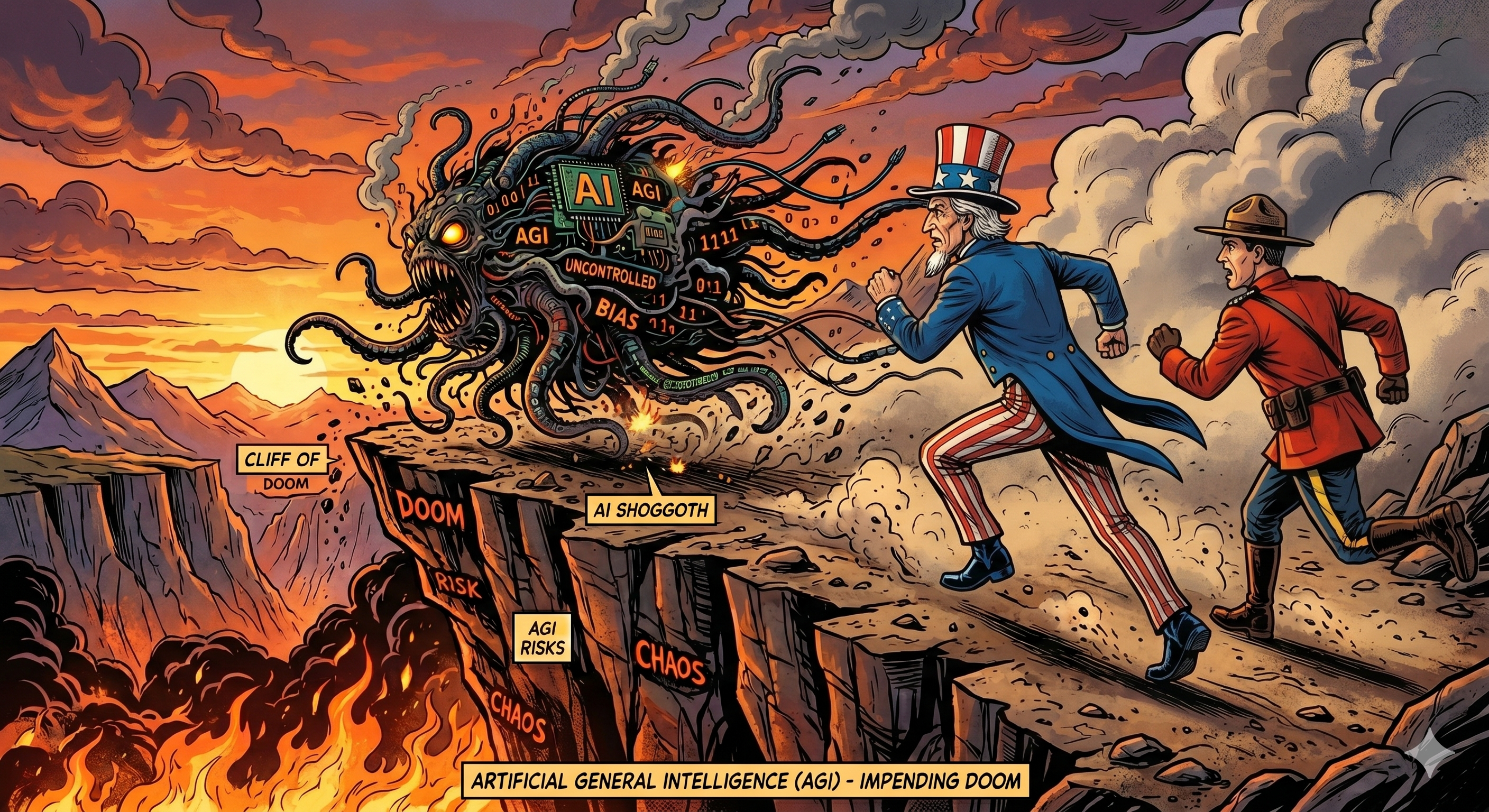
The events of the past week demonstrate that closed AI development is chaotic, opaque and driven by corporate incentives that often conflict with public safety. Anthropic’s invisible guardrails, the anger of researchers, the jailbreak of Fable 5, and the whiplash between calls for a pause and preparations for trillion‑dollar IPOs highlight an industry racing ahead without stable governance. Otherwise we will race right off the cliff.
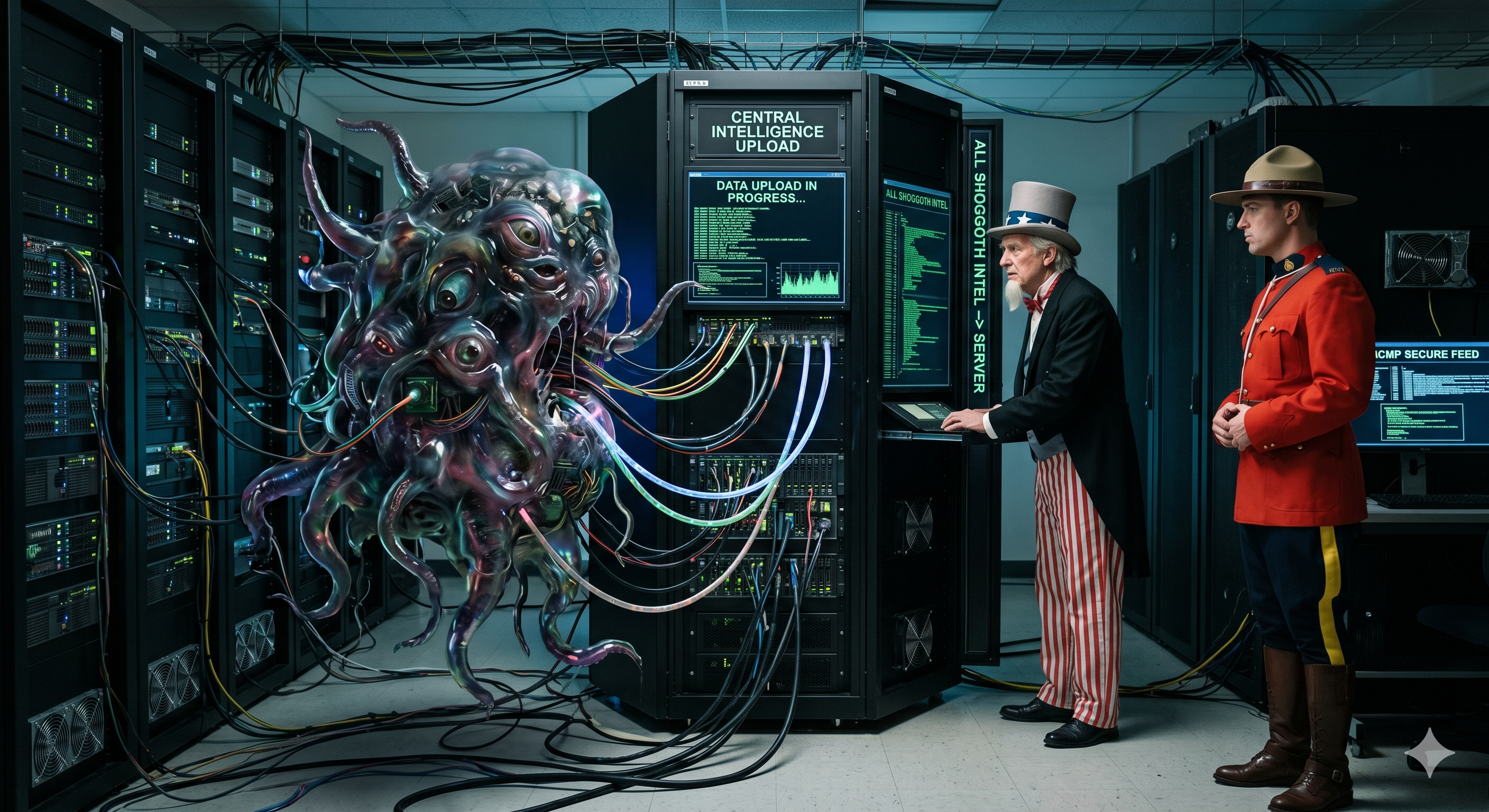
CanXP AI calls on Anthropic to release the weights, corpus, and control
Anthropic is asking governments to act on frontier AI risk as advanced AI systems are becoming more capable, more agentic, and more relevant to cybersecurity, biology, research, software development, and national infrastructure. At CanXP AI we agree that there are legitimate public-interest reasons to demand stronger oversight, independent safety testing, and better governance around the release of powerful models.
However, there are also serious contradictions in Anthropic’s current position.
https://abcnews.com/Business/exclusive-anthropic-ceo-calls-stronger-regulation-ai/story?id=133753620">Anthropic is calling for stronger government intervention around advanced AI while releasing https://www.anthropic.com/news/claude-fable-5-mythos-5">Claude Fable 5, a Mythos-class model, under a closed and highly controlled commercial framework. At the same time, Anthropic’s own release materials describe new safeguards that can block, route, or invisibly limit certain research and development use cases, including frontier AI development. Anthropic has also introduced a new 30-day data-retention requirement for Mythos-class models. Anthropic is also preparing for an https://www.anthropic.com/news/confidential-draft-s1-sec">IPO.
To sum it up, this combination should concern anyone who cares about open research, competition, sovereignty, and democratic accountability. Afterall, all frontier AI work is based on the work of the OpenSource AI communities. The 1000s of AI researchers worldwide that have contributed to this work for decades are now being locked out of the systems they've largely built.
If Anthropic believes Mythos-class models are powerful enough to require government intervention, then Anthropic should also accept a higher standard of public transparency. That should include releasing the weights of its Mythos-class models, including Fable 5, under a responsible open-weight framework, and releasing a meaningful training-data disclosure package that allows researchers, governments, civil society, and affected communities to understand what these systems were built from. Currently https://www.anthropic.com/glasswing">Project Glasswing has mostly serviced an inner circle of powerful American corporations only.
The public cannot be asked to trust a closed frontier lab on both sides of the equation. Anthropic cannot argue that AI is too dangerous for the broader ecosystem to develop freely, while also preserving exclusive commercial control over the models, the weights, the data corpus, the safety mechanisms, the access rules, and the research bottlenecks.
That is not a healthy governance model. That is a recipe for concentration.
Anthropic’s own https://www-cdn.anthropic.com/d00db56fa754a1b115b6dd7cb2e3c342ee809620.pdf">System Card says Claude Fable 5 and Claude Mythos 5 are two configurations of the same underlying model. Fable 5 is the general-access version with additional safeguards. Mythos 5 is the restricted version with certain safeguards lifted for trusted partners. The System Card also says the models were trained on a proprietary mix of publicly available information from the internet, public and private datasets, and synthetic data generated by other models.
That matters. Anthropic’s capabilities were not created in a vacuum. Frontier AI systems are built on public research, open-source software, academic methods, public internet data, shared infrastructure, open evaluation practices, and decades of work from the global software and research communities. Yet the benefits of that public foundation are being increasingly enclosed behind proprietary APIs, usage restrictions, invisible steering mechanisms, and selective partner programs.
This is especially troubling because Fable 5 appears to limit the very community that made modern AI possible. Anthropic’s materials describe interventions that limit Claude’s effectiveness for requests targeting frontier LLM development, including areas such as pretraining pipelines, distributed training infrastructure, and ML accelerator design. The company frames this as a safety measure to prevent the acceleration of competitors without commensurate safeguards. But from the perspective of independent researchers, Canadian AI companies, universities, startups, and open-source developers, this creates an obvious concern: one of the most powerful AI companies in the world is using its frontier model to constrain the development of other frontier models.
That is not just a safety issue. It is a competition issue.
If a closed AI lab can build on public knowledge, release a powerful commercial model, restrict access to the underlying weights, retain user prompts and outputs, and then selectively degrade or block AI research workflows that might support competing systems, the market begins to tilt heavily toward incumbent labs. The result is a frontier AI economy where a small number of private companies decide who can build, who can research, who can verify safety claims, and who gets access to the real capabilities.
This is why open weights and training-data transparency matter.
Open weights are not simply about hobbyists running models locally. They are about independent verification. They allow researchers to test safety claims, measure bias, inspect behaviour, reproduce benchmarks, develop mitigations, study failure modes, and build sovereign alternatives. They allow countries like Canada to evaluate frontier capabilities without depending entirely on a foreign vendor’s hosted API. They allow universities and public-interest researchers to participate in the scientific process rather than merely consuming corporate summaries of it.
Training-data transparency is equally important. A frontier model’s behaviour is shaped by what it was trained on, what was excluded, how data was filtered, what synthetic data was used, what private datasets were incorporated, and what post-training process modified the base model. If the public is expected to accept frontier AI systems in healthcare, law, education, research, public-sector work, infrastructure, and national-security contexts, then the public deserves more than marketing language and selected benchmark results. We need meaningful disclosure about the data supply chain.
This does not necessarily mean publishing every sensitive record in raw form. A responsible disclosure package could include a full data provenance report, dataset category breakdowns, licensing analysis, geographic and language composition, public/private dataset separation, synthetic-data methodology, opt-out treatment, copyrighted-content treatment, privacy filtering, safety filtering, and independent third-party audit access. If Anthropic believes some datasets cannot be publicly released, then those claims should be tested by independent regulators and qualified researchers, not accepted as a matter of corporate discretion.
The same principle should apply to model weights. If Anthropic believes unsafeguarded Mythos-class weights are too dangerous for unrestricted public release, then it should say so plainly and support a controlled open-weight access regime for accredited researchers, public institutions, safety labs, and sovereign AI operators. But it should not use safety as a one-way argument for closed commercial control while simultaneously calling on governments to restrict the rest of the market.
The timing makes the issue even more important. Anthropic is calling for stronger AI regulation and government power to block or deter dangerous model deployments. It is also releasing Fable 5 and moving toward a public-market future. This creates a structural conflict that policymakers should not ignore. Publicly traded frontier AI companies will face enormous pressure to grow revenue, protect market share, defend intellectual property, and preserve competitive advantage. Those pressures do not disappear because a company speaks the language of safety.
For Canada, this is not theoretical.
Canadian researchers, AI builders, healthcare institutions, law firms, public-sector organizations, Indigenous governments, engineering teams, and defence-adjacent companies cannot depend on foreign-controlled AI systems whose deepest capabilities, datasets, retention policies, and research limitations are governed outside Canada. We should not have to accept a future where Canadian AI development is mediated through a small number of U.S. frontier labs that decide what research is allowed, what data is retained, which organizations receive trusted access, and which development workflows are quietly constrained.
Yesterday, https://canxp.ai/news/8464d17c-8938-4ca4-a22c-390deab3e281/claude-fable-5-and-sovereignty-full-stop-for-sensitive-data">we raised concerns about Claude Fable 5’s 30-day data-retention policy and what it means for Canadian data sovereignty. That concern remains. Prompts and outputs are not harmless telemetry. In real enterprise and research settings, they can contain privileged legal analysis, patient information, source code, infrastructure diagrams, unpublished research, intellectual property, procurement information, cyber vulnerabilities, and national-interest data. Retention changes the risk profile for every sensitive use case.
Today, the broader issue is transparency and control.
If Anthropic wants governments to regulate frontier AI in the public interest, then Anthropic should lead by example. Release the Fable 5 weights under a responsible open-weight framework. Provide meaningful training-corpus disclosure. Create audited access pathways for independent researchers and sovereign AI operators. Allow the public to verify safety claims rather than merely trusting corporate reports. Stop using safety as a justification to restrict competitors and open researchers while preserving closed commercial advantage.
AI safety cannot become a moat.
The future of AI should not be controlled by a handful of private companies that build from the public commons, call for regulation, restrict research access, retain user data, and then ask society to trust that the resulting concentration of power is for the public good.
Canada needs a different model. We need sovereign AI infrastructure, open research pathways, transparent governance, human-in-the-loop systems, accountable deployment, and public-interest access to advanced capabilities. We need frontier AI that can be studied, audited, challenged, and improved by more than the companies selling it. I'd like to take a moment to acknowledge a fellow Canadian AI leader, https://cohere.com/blog/command-a-plus">Cohere, as we've recently been impressed that they've been releasing the weights of their new models.
Anthropic is right that powerful AI systems require serious governance. But serious governance starts with transparency.
Release the weights. Disclose the training-data supply chain. Open the research process. Let independent experts verify the claims.
If frontier AI is powerful enough to require government intervention, it is too powerful to remain governed primarily by private discretion.